
Argentina: M&A Market Overview & 2026 Outlook
Updated: Aug 5

Argentina's M&A market is not for the underprepared. Deal volume is smaller than regional peers, currency risk is acute, and the political and regulatory environment requires underwriting that most cross-border buyers are unwilling to perform rigorously. For those who do, the market offers real opportunity — particularly in energy, mining, and digital assets where the investment thesis does not depend on macro stability to deliver returns.
This is the fifth report in Frontera Capital Advisors' six-part Latin America M&A series. Prior posts covered the regional overview, Brazil, Mexico, and Colombia. This post examines Argentina's specific market dynamics, the structural characteristics that define deal-making in the country, and the outlook for 2026.
Argentina's Position in the Regional Market
Argentina is a structurally active M&A market despite a deal volume that is smaller than its GDP weight would suggest. The gap between economic potential and transaction activity is explained almost entirely by the country's recurring macro instability: currency controls, sovereign debt cycles, FX volatility, and periodic shifts in the regulatory and policy environment suppress the category of deal-making that depends on financing, predictable exit timelines, or hard-currency repatriation.
What remains active — and what defines Argentina's deal market — is a more selective category of transaction: assets where the investment thesis is grounded in hard-currency-linked revenues (hydrocarbons, mining royalties, export-oriented agriculture), digital and software businesses with global revenue diversification, or financial sector repositioning driven by structural rather than cyclical logic. These categories generate consistent deal flow regardless of the macro backdrop, because the underlying thesis does not require Argentina to "fix itself" to deliver returns.

Source: TTR Data. Figures include M&A, PE, VC, and asset acquisitions; joint ventures excluded.

Source: TTR Data. Figures include M&A, PE, VC, and asset acquisitions; joint ventures excluded.
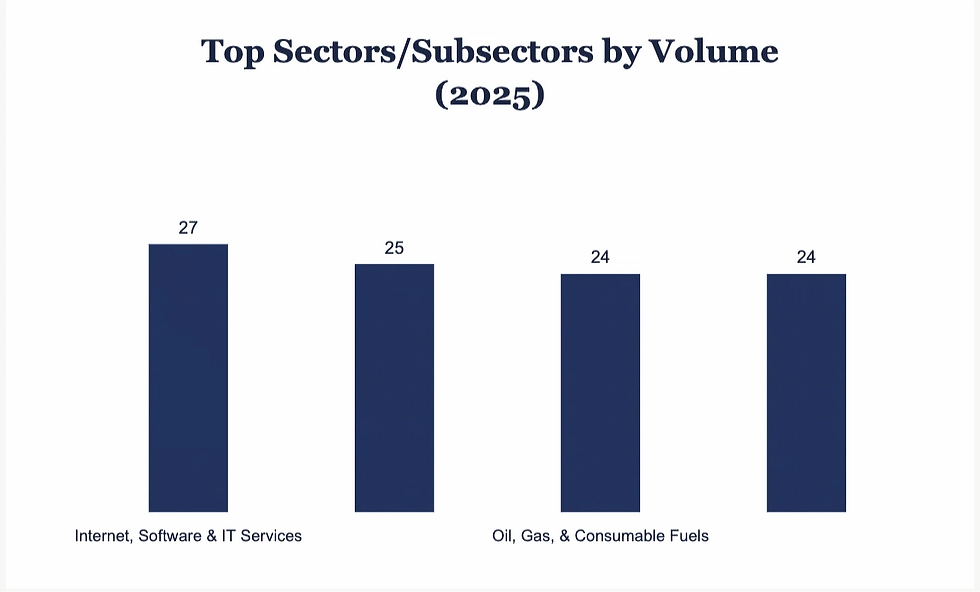
Source: TTR Data. Figures include M&A, PE, VC, and asset acquisitions; joint ventures excluded.
Market Dynamics and 2026 Outlook
Argentina's M&A activity in 2025 reflected active deal-making despite smaller overall volume — a characterization that matters. The market is not dormant; it is selective. Transactions are happening, but they are concentrated in sectors and asset types where the underlying economics are sufficiently compelling to justify navigating the country's risk environment.
The Milei administration's economic reform program — deregulation, fiscal consolidation, and gradual currency normalization — has altered the investment conversation materially. Investor confidence, while not fully restored, has improved meaningfully from the lows of recent years. The question for 2026 is not whether Argentina is open for business, but whether the reform trajectory holds, how quickly exchange rate and regulatory clarity improve, and which sectors are positioned to benefit first from a normalization scenario.
The 2026 outlook is for continued selective activity: sustained interest in energy and mining where the thesis is clear and hard-currency revenues provide natural protection, continued tech and internet deal flow by volume, and financial sector repositioning as the banking system adapts to a reformed macro environment. Larger deals will remain concentrated and sponsor-led, with increased use of risk-mitigation structures — insurance, escrows, earn-outs — to bridge the valuation and execution gaps that persist in a high-uncertainty environment.

FX AND FINANCING OUTLOOK
The Argentine peso (ARS) is likely to remain volatile with a significant country risk premium throughout 2026. Exchange rate clarity — specifically the pace and credibility of currency normalization — will be the single most important variable for cross-border deal pricing. Buyers cannot underwrite an Argentine acquisition on the assumption of stable ARS; they must structure around hard-currency-linked revenues, build FX scenarios into their valuation models, and accept that the spread between ARS and hard-currency valuation frameworks will persist for the foreseeable term.
International financing for Argentine deals is constrained. The sovereign risk premium makes leveraged buyout structures, in the traditional sense, difficult to execute. Most cross-border transactions in Argentina are equity-heavy; leverage, where available, comes from local banks and is priced accordingly. Buyers who accept this structural reality and underwrite deals on an equity-return basis — rather than trying to apply leverage multiples more appropriate for other markets — will find more executable transactions.
Argentina is a market where the gap between the opportunity and the risk is real — and large. The buyers who perform well here are not those who ignore the risk, but those who underwrite it precisely and structure around it systematically.
Notable 2025 Transactions
Argentina's 2025 notable transactions were concentrated in the sectors described above — energy and mining leading on headline value, technology and internet active by volume, and financial services transactions reflecting sector repositioning. Key themes from the verified deck narrative include: energy and mining transactions leading headline deal value; strong technology and internet activity by volume; financial sector repositioning; infrastructure and transport deals linked to airport consolidation and logistics; and private equity selectively active on platform and growth acquisitions, with larger deals concentrated and sponsor-led.
What to Watch in 2026
Vaca Muerta is the most consequential single-asset story in Argentina's deal market. The Neuquén shale formation is among the most significant non-US shale resources globally, and the pace of development — pipelines, processing, export infrastructure, and upstream acreage — is generating deal flow across the value chain. Buyers in this space are largely energy-sector strategics and infrastructure funds with the technical capability to underwrite the asset and the risk tolerance to hold through Argentina's political cycle.
Lithium is the second major hard-asset theme. Argentina sits within the Lithium Triangle alongside Chile and Bolivia, and the global energy transition's demand for battery materials has generated sustained interest from mining companies, automakers, and battery manufacturers. Transactions in this space tend to be early-stage — joint ventures, offtake agreements, and exploration-stage acquisitions — rather than operational asset M&A, but they represent a meaningful and growing component of deal flow.
The technology and digital sector will continue to generate volume-level deal activity regardless of the macro environment. Argentina has a well-developed software engineering talent base and a mature startup ecosystem — anchored by companies like Mercado Libre but extending across SaaS, fintech, and e-commerce. Digital businesses with USD-denominated revenue or export-oriented service models are structurally insulated from ARS volatility and will continue to attract both domestic and cross-border buyers.
Deal structure will be the differentiator for serious buyers in 2026. Representations and warranties insurance, escrow arrangements calibrated to regulatory and currency risk, and earn-out structures tied to hard-currency performance metrics are not optional features in Argentina — they are baseline requirements for executable cross-border transactions. Buyers who approach Argentina with the same structural assumptions they apply to Chile or Colombia will find transactions that appear attractive on paper but are impossible to close on acceptable terms.
Argentina in 2026 is a deal-by-deal market. There is no broad-market strategy that works here. What works is sector conviction, rigorous risk underwriting, and a structuring toolkit built specifically for the country's macro environment.
This report has been prepared by Frontera Capital Advisors, LLC ("Frontera") for general informational purposes only. The views expressed herein are those of the author(s) as of the date of publication and are subject to change without notice.
Information contained in this article has been obtained from sources believed to be reliable, but Frontera has not independently verified such information and makes no representation or warranty, express or implied, as to its accuracy, completeness, or reliability. Any forward-looking statements, projections, or opinions reflect the author's judgment as of the date of publication and may prove to be incorrect.
Nothing in this article constitutes legal, tax, accounting, investment, or other professional advice, nor should it be construed as a recommendation, offer, or solicitation to buy or sell any security, engage in any transaction, or pursue any strategy. Readers should consult their own legal, tax, financial, and other advisors before making any decision based on the contents of this article.
Frontera Capital Advisors, LLC is a corporate finance advisory firm. References to transactions, market conditions, or third parties are for illustrative purposes only and do not constitute an endorsement or representation regarding any specific party or transaction.
© 2026 Frontera Capital Advisors, LLC. All rights reserved.


